

we call our selves back to ourselves.
we hear the voice of the ancestors calling us.
we remember the calling of our names.
we remember the covenant,
the liminality of shapeshifting
that requires rest and time.
rest is not the reward but the recipe.
we know the next best thing
is to sat down somewhere,
for patience with self is love,
being still is movement,
and being present is the present.
we call our selves back to ourselves.
--Dreaming the Multiverse oracle poem
guided by Austen Smith, Vision Keeper of ImaginationDoulas, word weaving by elle roberts at Iranti Ẹ̀jẹ̀: Remembering Blood
This past October, The Black Girl’s Guide to Surviving Menopause convened Iranti Ẹ̀jẹ̀: Remembering Blood, the first international intergenerational menopause conference centering the Global Majority, LGBTQIA+ individuals, and formerly incarcerated people.
In this first-of-its-kind space, healthcare providers, including Midwives, connected menopause to the continuum of reproductive care, expanding their practices to support people well beyond childbearing years.
Mental health professionals and sexologists integrated culturally rooted, gender-inclusive approaches into their counseling and therapeutic work.
Reproductive justice advocates and abolitionists exchanged strategies for linking menopause care to broader fights for bodily autonomy and freedom from state violence.
Community members saw their own experiences reflected and valued, which shifts how they think about their bodies, their care options, and their right to shape the policies and systems that affect their lives.
The video above highlights the sacredness of this gathering, produced by Comfrey Films, a Film Training Program and Production House designed to launch Black trans, gender non-conforming, and intersex (TGNCI) storytellers into independent filmmaking and to tell stories woven at the intersection of being Black and TGNCI.
Below are two more pieces of ranti Ẹ̀jẹ̀: ephemera from a conference participant and one of our elemental speakers.
Iranti Ẹ̀jẹ̀: A Digital Quilt for the Global Majority
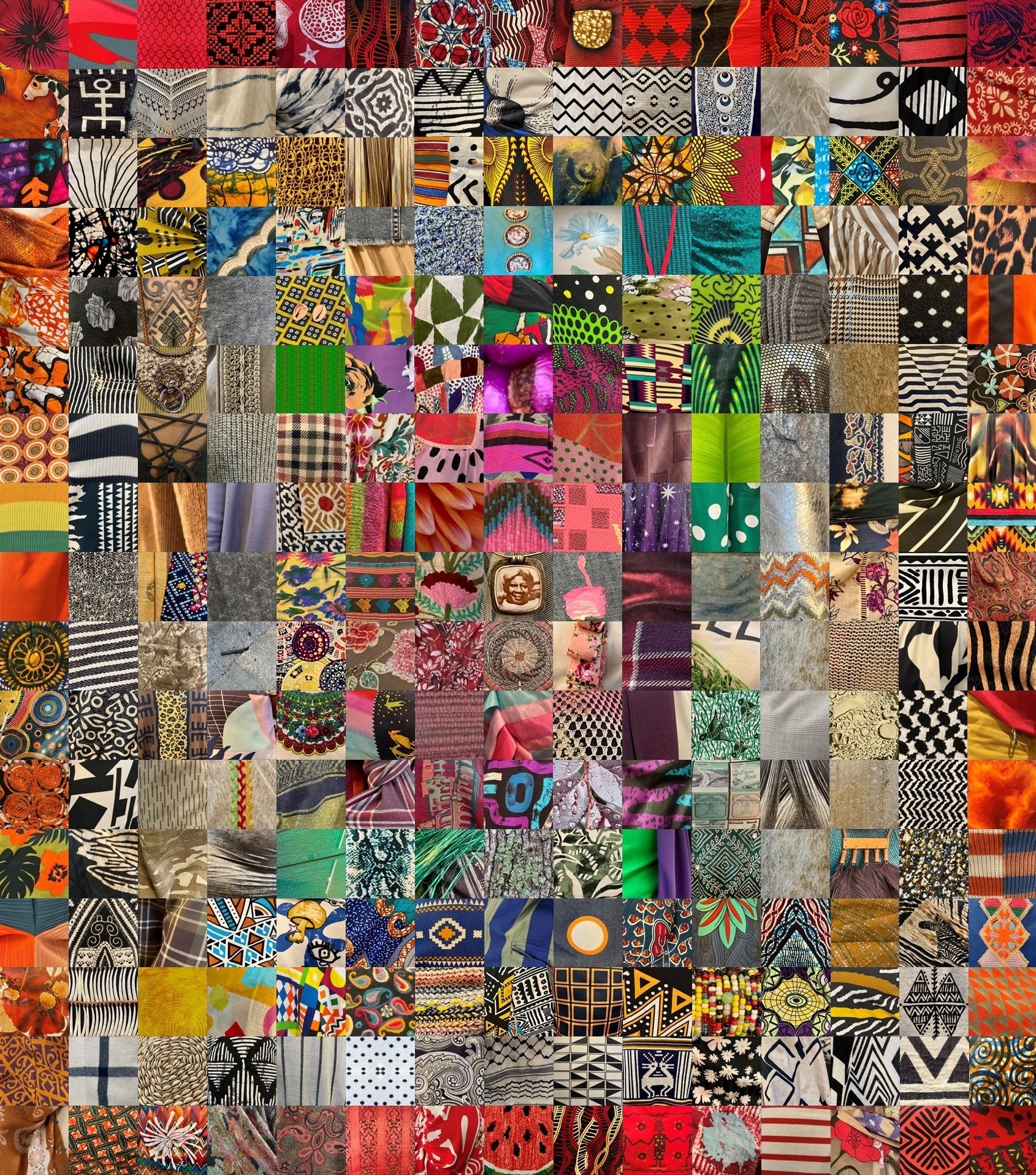
Artist Statement
Beginning with its red Ẹ̀jẹ̀ border and traveling to the Iranti image at its center (jewelry featuring Omisade Burney-Scott’s mother Mary Ella Kinsey Burney) this digital quilt’s mosaic pattern is structured as a soft rectangle, like an open door, perhaps even the passage you may cross as part of your menopausal transition.
Featuring 255 squares this digital quilt contains kufis and ball caps, ceremonial skirts and saris, leather and fringe, moss, tree bark, and rain. Whale bone and wax print. Fans and head wraps, a purse that a mother made with care, a well-loved gift from a friend. Pils and pet hair, wrinkles and stains, tattoos and melanin, bogolan and baby clothes, kente, cotton, metal and silk. Flowers, foliage, and fabrics from conference organizers, volunteers, event space staff, and even parts of the building where the Iranti Ẹ̀jẹ̀ conference was held.
And most importantly, under each square are our hips and thighs, our shoulders and arms, our chests that hold the rhythm of our heartbeats, that released our deeply held breath, and that brim still with our collective song.
The hope is that you will find yourself in this quilt, but even if your outfit was not photographed at the conference, please know that if you were in attendance in person, online, or in spirit, each of you helped create a thread in this quilt which was woven, for the diaspora and the global majority, with respect and love.
Rachel Hughes, @croyland
Born in Virginia, raised in Rhode Island, Rachel Hughes is a Bajan American artist and writer who calls Providence home.
Dreaming the Multiverse Oracle Poem
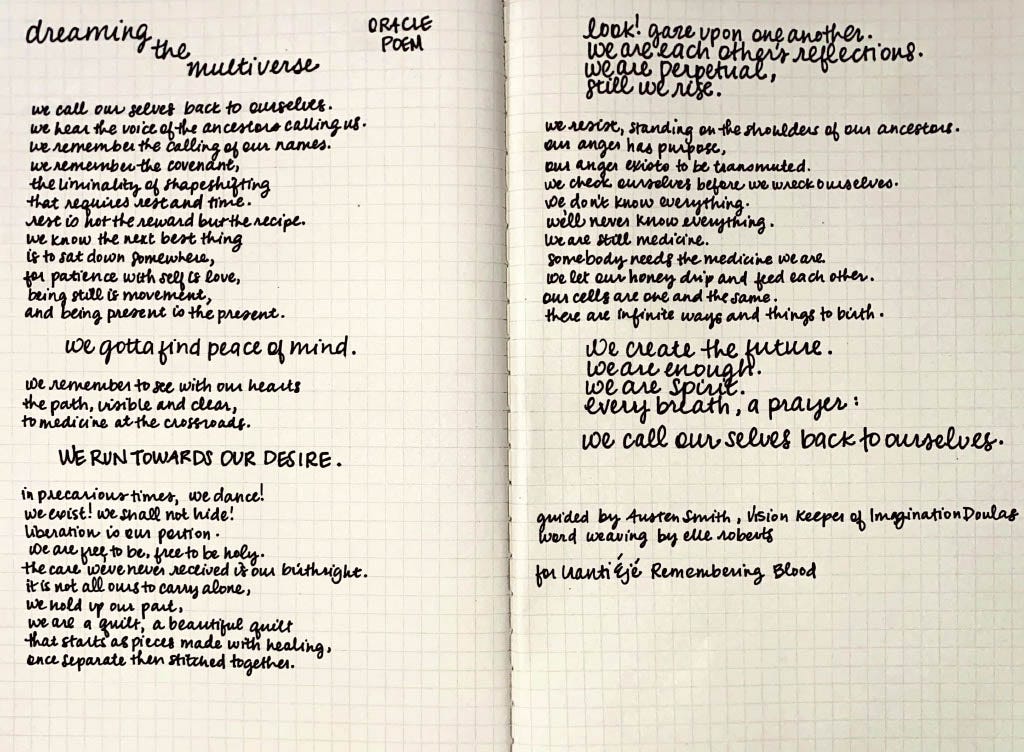
Each day, conference participants were guided by Air elemental speaker Austen Smith, Vision Keeper of ImaginationDoulas, in a daily ritual of dreaming the Menopausal Multiverse. The words above reflect our collective dream of a menopause ecosystem that is diverse, expansive, inclusive, healing, ancient, futuristic, queer, loving, safe, and radical. Word Weaving by elle roberts
What We Heard From Participants
Across more than 70 pages of feedback from conference participants, one theme rose again and again:
“This wasn’t a conference, this was medicine.”
People described feeling:
Seen, validated, and transformed
Connected to history, community, and ritual
Grounded in political, spiritual, and embodied wisdom
Cared for in ways they had rarely experienced
Additional reflections from conference participants
“History was made with this conference! This is the very first and only of its kind to exist with such an expansive framework. This is work that needs to continue and keep going because the education, the gathering, and the sense of community is needed.”
“Being in a space of mostly Black women, femme, Trans and gender expansive people, dancing, speakers, the care and nourishment, doing the conference together with my friend.”
“I will bring others next year.”
As we prepare to step into 2026, the invaluable lessons from Iranti Ẹ̀jẹ̀ are expanding the ways the Black Girl’s Guide to Surviving Menopause engages in narrative and culture shift work for those whose menopause experiences and needs are left at the margins.
We are building a year-round global menopause ecosystem devoted to:
Menopause curriculum, education, and training
Advancing intersectional research led by our team in partnership with Dr. Monica McLemore of NYU’s School of Nursing and shaped by the lives of Black women, queer folks, trans and gender expansive people, currently/formerly incarcerated people, and anyone pushed to the edges of care
Intergenerational community building
Expanded menopause care access for marginalized communities at the intersections of abolition and Disability Justice
Sustainable support for elders, midwives, nurse practitioners, doctors, and culture-bearers
Digital offerings and international learning spaces
Follow us on Instagram and keep an eye on our website for updates.

